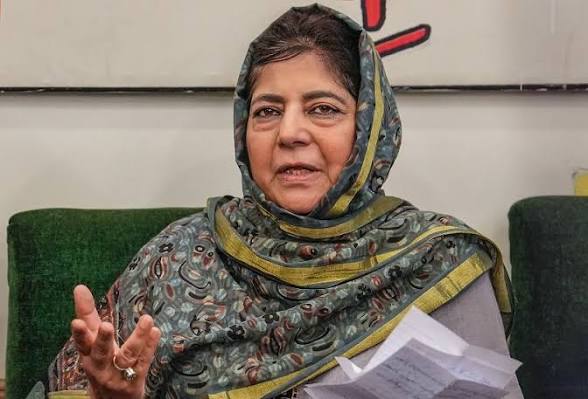

Mehbooba Mufti Biography
Mehbooba Mufti biography is one of the most searched topics in Indian politics because her life connects family legacy, electoral politics, Kashmir’s regional history, parliamentary leadership, and one of the most closely watched chief ministerships in modern India. She is widely known as a former Member of the Lok Sabha from Anantnag, the president of the Jammu and Kashmir Peoples Democratic Party, and the first woman to serve as Chief Minister of Jammu and Kashmir. Public records and widely cited biographical references identify her birth date as 22 May 1959, her parliamentary representation of Anantnag in the 14th and 16th Lok Sabha, and her later role as Jammu and Kashmir’s first female chief minister.
This detailed, AdSense-friendly article covers her early life, education, family background, political rise, Lok Sabha journey, leadership style, major controversies, achievements, and lasting place in Indian politics. The writing is designed to be clear, informative, and useful for readers searching for a complete and readable profile.
Quick Profile
| Field | Details |
|---|---|
| Full Name | Mehbooba Mufti Sayed |
| Popular Name | Mehbooba Mufti |
| Date of Birth | 22 May 1959 |
| Birthplace | Bijbehara, Jammu and Kashmir, India |
| Nationality | Indian |
| Profession | Politician |
| Political Party | Jammu and Kashmir Peoples Democratic Party (PDP) |
| Father | Mufti Mohammad Sayeed |
| Mother | Gulshan Ara |
| Spouse | Javed Iqbal Shah |
| Children | Iltija Mufti, Irtiqa Mufti |
| Education | English literature graduate; law degree from the University of Kashmir |
| Known For | Former Lok Sabha member, PDP leader, first woman Chief Minister of Jammu and Kashmir |
| Lok Sabha Constituency | Anantnag |
| Lok Sabha Terms | 2004–2009 and 2014–2016 |
| Major Leadership Role | Chief Minister of Jammu and Kashmir, 2016–2018 |
Introduction
Mehbooba Mufti occupies a unique place in Indian public life. Many politicians gain recognition through a single office, but her profile developed through several stages: grassroots politics, assembly politics, opposition leadership, parliamentary representation, party leadership, and executive authority. Her career also unfolded during one of the most sensitive and politically complex phases in Jammu and Kashmir’s history.
She is the daughter of Mufti Mohammad Sayeed, a major political figure who served in national and regional politics and founded the People’s Democratic Party. Mehbooba Mufti inherited not only a political surname but also a demanding political landscape. Yet her rise was not merely dynastic. Over the years, she built a direct mass connection, especially in parts of South Kashmir, and became one of the most visible faces of regional politics in Jammu and Kashmir. Her career includes victories in the state assembly, terms in the Lok Sabha, leadership of the PDP, and the chief minister’s office.
For readers researching Indian politicians, Mehbooba Mufti’s biography is important because it reflects the intersection of gender, regional identity, coalition politics, family legacy, and conflict-era governance. Her story is not simply that of an elected leader. It is also the story of a politician who operated at the center of emotional, constitutional, and security debates that shaped contemporary Kashmir.
Early Life and Family Background
Mehbooba Mufti was born on 22 May 1959 in Bijbehara, in Jammu and Kashmir. She comes from a politically prominent family. Her father, Mufti Mohammad Sayeed, was among the most influential politicians associated with Jammu and Kashmir in the post-independence era and later founded the PDP. Her mother is identified in public biographical records as Gulshan Ara.
Growing up in such a family exposed Mehbooba Mufti to politics, public service, and the realities of power from an early age. But early exposure does not automatically create a political career. In her case, family background gave her access to political culture, while the region’s complex circumstances gave her a difficult arena in which to prove herself.
Jammu and Kashmir was never an ordinary electoral field. Political legitimacy there required more than speeches and campaign slogans. Leaders were often judged by accessibility, courage, local credibility, and their ability to respond to grief, unrest, and political uncertainty. Mehbooba Mufti’s later political identity was shaped heavily by her image as a leader who reached out directly to people during difficult times.
Her background also matters because it helps explain her later leadership within the PDP. The party’s identity was tied closely to the vision of her father, but Mehbooba Mufti became the most visible inheritor and interpreter of that legacy. Over time, she came to represent the emotional and political continuity of the party.
Education
Public biographical references note that Mehbooba Mufti studied English literature and later obtained a law degree from the University of Kashmir. These educational details are often highlighted in profiles because they reflect both literary and legal training—two areas that can shape political communication and institutional understanding.
Her educational path helped build the foundations for public life. A background in literature often develops reading, language, interpretation, and expression. Legal education, meanwhile, exposes a student to systems, rights, procedure, and constitutional thinking. In the case of a politician operating in a region marked by law-and-order debates, civil liberties questions, and governance disputes, that legal grounding becomes especially relevant.
Education alone does not explain her political style, but it likely contributed to the way she communicated and framed issues. Throughout her career, Mehbooba Mufti has often presented herself as a politician concerned with both emotional realities on the ground and institutional questions relating to democratic process and public representation.
Personal Life
Mehbooba Mufti married Javed Iqbal Shah, and public biographies note that they later separated. She is the mother of two daughters, Iltija Mufti and Irtiqa Mufti. Her daughter Iltija Mufti has also become publicly visible in political contexts and is identified in recent public references as a politician associated with the PDP.
In political biographies, personal life is often reduced to names and relationships, but in her case it has also intersected with public narratives. Family remains central to her political image, not only because of her father’s legacy but also because later public attention extended to her daughter’s role and visibility. This multi-generational dynamic has kept the Mufti family in the political spotlight.
At the same time, Mehbooba Mufti has usually been discussed in the public arena less as a private figure and more as a political actor. Her personal life, while relevant to biography readers, has generally remained secondary to debates around elections, party strategy, governance, Article 370, coalition politics, and the future of Jammu and Kashmir.
Entry Into Politics
Mehbooba Mufti’s formal political rise began in the 1990s, a period when Jammu and Kashmir was going through deep political and security turmoil. Public biographical material notes that she became one of the popular members elected from Bijbehara in the 1996 assembly elections on a Congress ticket. That period was politically significant because electoral participation in Jammu and Kashmir carried unusual risk and symbolism.
Her early political career showed that she was not content to remain in the background as the daughter of a prominent leader. She entered the arena directly, contested elections, and built a public identity around active engagement. This helped distinguish her from purely symbolic political heirs.
One of the most important aspects of her early rise was her image as a grassroots politician. She cultivated support by being physically present in communities, interacting with families, and responding to public suffering in visible ways. In a region where many people judged politics through lived experience rather than party manifestos alone, this mattered a great deal.
Her early years also demonstrated strong political stamina. Politics in Jammu and Kashmir required patience, resilience, and a willingness to face criticism from multiple sides. Mehbooba Mufti began developing that resilience well before she became a national figure.
Role in the Formation and Rise of the PDP
The Jammu and Kashmir Peoples Democratic Party (PDP) was founded in 1999 by Mufti Mohammad Sayeed, and Mehbooba Mufti became one of its most important public faces. Today, public references continue to identify her as the party’s president.
The PDP emerged as an alternative political force in Jammu and Kashmir. It sought to create a distinctive political identity in a region long shaped by a few dominant players. While her father provided the founding leadership, Mehbooba Mufti played a major role in taking the party to the people, especially through outreach and mobilization.
As the party grew, so did her public stature. She was no longer merely a leader’s daughter or a local legislator. She became one of the recognizable architects of the PDP’s expansion. Her connection to the electorate gave the party an emotional, people-facing dimension that complemented its organizational leadership.
Her growth within the party also reflected a larger truth about regional politics: charisma and accessibility can matter just as much as ideology. Mehbooba Mufti helped make the PDP feel relatable to many voters. She projected empathy, defiance, and familiarity, and those qualities strengthened her political brand.
Eventually, after the death of Mufti Mohammad Sayeed in January 2016, Mehbooba Mufti succeeded him as both party leader and chief ministerial figure, consolidating her position as the central face of the PDP.
Mehbooba Mufti as a Member of the Lok Sabha
One of the most searched parts of the Mehbooba Mufti biography is her parliamentary career. She represented Anantnag in the 14th Lok Sabha (2004–2009) and again in the 16th Lok Sabha (2014–2016). These terms are central to her national political profile.
Her role as a Lok Sabha member mattered for several reasons. First, it gave her a national parliamentary platform beyond regional politics. Second, it connected the concerns of her constituency to debates within India’s national legislature. Third, it strengthened her standing within the PDP and among supporters who saw her as capable of representing Kashmir’s issues at the national level.
Representing Anantnag in Parliament was politically significant because the constituency has symbolic and electoral importance in South Kashmir. Winning there showed that she had durable voter support in a politically sensitive region. Her Lok Sabha victories were not just numbers on an election chart; they were demonstrations of political relevance.
Parliamentary representation also enhanced her political maturity. It exposed her more directly to national-level political negotiations, public scrutiny, media attention, and institutional processes. That experience likely helped prepare her for the executive responsibilities she later assumed as chief minister.
For biography readers and publishers seeking AdSense-friendly political content, this Lok Sabha chapter is crucial because it broadens the article’s value beyond regional readership. Mehbooba Mufti is not only a Jammu and Kashmir figure; she is also a national parliamentary figure with a recorded legislative career.
Leadership in the Jammu and Kashmir Assembly
Before and between her parliamentary roles, Mehbooba Mufti also held an important place in the politics of the Jammu and Kashmir Legislative Assembly. She served as a legislator and later as Leader of the Opposition, a role that helped establish her as a serious political contender rather than merely a symbolic leader. Public biographies note her strong opposition posture during the Farooq Abdullah period.
Opposition leadership is often an underrated part of a politician’s biography. Executive office gets headlines, but opposition work can reveal discipline, message control, and ability to shape public debate. In Mehbooba Mufti’s case, this phase helped sharpen her image as a combative and emotionally expressive politician.
The assembly years also gave her direct experience with regional governance structures, constituency pressures, coalition realities, and policy disagreements. These experiences later influenced her approach as party chief and chief minister.
Becoming the First Woman Chief Minister of Jammu and Kashmir
One of the defining milestones in Mehbooba Mufti’s political career came on 4 April 2016, when she became the first woman Chief Minister of Jammu and Kashmir. She succeeded after the death of her father, Mufti Mohammad Sayeed, and continued the coalition arrangement involving the PDP and the BJP. Public references identify her as the 9th Chief Minister of the erstwhile state and confirm the dates of her tenure from 4 April 2016 to 19 June 2018.
This moment was historic. In a region marked by patriarchal political traditions and intense conflict, a woman assuming the top executive office carried both symbolic and political weight. It drew attention nationally and internationally.
But the symbolism came with high expectations and immense pressure. She was not taking charge in calm conditions. She was leading a politically sensitive region with deep divisions, security challenges, governance demands, and a controversial coalition arrangement. Her chief ministership was therefore historic not only because she was the first woman in the role, but because she occupied it during an exceptionally difficult period.
Her rise to chief minister was also closely watched because it raised questions about inheritance versus independent authority. Could she move from being seen as Mufti Mohammad Sayeed’s successor to being recognized as a governing leader in her own right? Her time in office became the testing ground for that question.
Coalition Politics and Governance Challenges
Mehbooba Mufti’s tenure as chief minister was shaped heavily by coalition politics. The PDP-BJP alliance was always unusual and controversial. The two parties represented different political constituencies, ideological instincts, and voter expectations. Holding such an alliance together required political balancing of the highest order.
For Mehbooba Mufti, this challenge was both strategic and personal. She had to reassure her support base while working with a national party whose image and political priorities were often viewed with suspicion by many in Kashmir. This tension became one of the defining themes of her tenure.
Coalition governments often require compromise, but in conflict-sensitive regions compromise can easily be interpreted as betrayal by one side or weakness by another. That was the trap she had to navigate. Every move invited criticism. Supporters expected compassion and firmness on regional issues. Coalition partners expected functional cooperation. Opponents looked for every sign of inconsistency.
Her government also had to respond to public anger, unrest, and security-related developments. The chief minister’s office in Jammu and Kashmir was never just an administrative role; it was also a symbolic office carrying the burden of public trust in a contested space.
Public Image and Political Style
Mehbooba Mufti’s political style has long been associated with emotional outreach, grassroots contact, and strongly worded public positioning. Unlike leaders who maintain an exclusively institutional tone, she often appeared as a politician trying to embody empathy and proximity. This helped her build a loyal following, especially among sections of the electorate that valued visible presence and direct engagement.
Her supporters have often viewed her as someone willing to speak uncomfortable truths, especially on issues relating to Kashmir’s political grievances, civil liberties, and regional dignity. Her critics, on the other hand, have at times accused her of inconsistency, symbolism, or political opportunism. Like many major regional leaders, her public image depends heavily on the political lens through which she is viewed.
Still, there is little doubt that she developed a distinct political personality. She was not an anonymous party functionary. She became one of the most recognizable and debated faces of Jammu and Kashmir politics.
Resignation in 2018
Mehbooba Mufti’s tenure as chief minister ended on 19 June 2018, when the BJP withdrew support from the coalition government, leading to her resignation. Public summaries note that the alliance ended amid worsening tensions and disagreement over the security and political situation.
Her resignation was a major political moment. It marked the collapse of one of the most unusual experiments in Jammu and Kashmir politics. For observers, it confirmed just how fragile the coalition had always been. For her supporters, it reinforced the argument that the political arrangement was fundamentally unstable. For critics, it raised questions about whether the alliance should have existed in the first place.
This episode remains central to her biography because it shaped public judgments about her chief ministership. Some saw her as a leader who tried to keep a difficult arrangement alive for the sake of governance. Others saw her as having paid a political cost for entering an uneasy alliance. Either way, the end of the coalition marked a turning point.
After Article 370: Detention and Political Repositioning
After the revocation of Article 370 in August 2019, Mehbooba Mufti was detained, a development widely reported and reflected in public biographical summaries. That period altered the political landscape of Jammu and Kashmir and also transformed the context in which her politics would be understood afterward.
The post-2019 phase is essential in any updated biography of Mehbooba Mufti because it repositioned her as a leader speaking from a dramatically changed constitutional and political environment. Her statements and politics after this period have been interpreted through the lens of constitutional change, regional identity, and democratic representation.
This stage of her public life also kept her relevant even outside formal office. Many politicians fade after electoral defeat or executive exit. Mehbooba Mufti remained a significant figure because the issues at the center of her politics did not disappear.
2019 and 2024 Electoral Setbacks
Public records summarized in major biographical pages note that Mehbooba Mufti lost the 2019 Lok Sabha election from Anantnag and also lost the 2024 Lok Sabha election from Anantnag-Rajouri. These defeats matter because they show that even highly recognizable leaders face changing voter moods and transformed electoral terrain.
Electoral defeat does not erase political influence, but it does change the tone of a biography. It introduces questions about strategy, relevance, party strength, and the durability of personal vote banks. For Mehbooba Mufti, recent defeats are part of the broader story of how Jammu and Kashmir politics has evolved in the last several years.
Still, her continuing position as president of the PDP shows that her role in regional politics remains important, even when electoral results are mixed.
Mehbooba Mufti and Women in Politics
A major reason for lasting interest in the Mehbooba Mufti biography is her significance as a woman political leader in a region where the highest executive office had not previously been held by a woman. Her becoming the first female chief minister of Jammu and Kashmir was a landmark moment.
Her career offers an important case study for women in Indian politics. She inherited a legacy, yes, but she also had to survive direct electoral tests, public scrutiny, media pressure, and an unforgiving political environment. Women leaders are often judged by harsher standards, and that is especially true in conflict-sensitive or deeply polarized settings.
Her political journey demonstrates that women in Indian politics can lead mass-based regional parties, handle coalition negotiations, command electoral campaigns, and occupy top executive offices. Whether one agrees with her politics or not, her role in expanding the visible space for women in political leadership is undeniable.
Achievements
Mehbooba Mufti’s achievements can be understood in political, symbolic, and organizational terms.
First, she built a recognized identity as a mass leader in Jammu and Kashmir. That is an achievement in itself because the region’s politics is highly competitive and emotionally charged.
Second, she served two terms in the Lok Sabha, proving that she could win not only regional visibility but also parliamentary legitimacy.
Third, she became the first woman Chief Minister of Jammu and Kashmir, entering the history books in a direct and permanent way.
Fourth, she successfully took over the leadership mantle of the PDP after her father’s death and continues to be publicly identified as the party’s president. Maintaining leadership in a regional party after the death of its founder is not easy, and many such parties fragment quickly.
Fifth, she has remained politically relevant through multiple transitions, including coalition collapse, constitutional change, detention, and electoral losses. Longevity matters in politics, and she has shown it.
Criticism and Controversy
No serious political biography is complete without discussing criticism. Mehbooba Mufti’s career has been marked by several controversies, many of them tied to the broader political crisis of Jammu and Kashmir rather than to personal scandal.
The biggest criticism concerns the PDP-BJP alliance. Many critics argued that the coalition confused or disappointed the PDP’s support base. Some believed the ideological gap between the two parties was too wide to sustain. Others argued that entering the alliance damaged the PDP’s credibility in Kashmir.
Another area of controversy involves responses to unrest and security issues during her tenure as chief minister. In such a sensitive region, every policy choice is intensely contested, and chief ministers are often blamed from multiple directions at once.
There has also been criticism of dynastic politics, with opponents arguing that the Mufti family’s influence reflects a wider pattern in Indian politics. Supporters respond that electoral success, leadership endurance, and public recognition cannot be explained by surname alone.
These debates are part of what makes her biography compelling. She is not a neutral or uncontroversial figure. She is a consequential one.
Leadership Legacy
Mehbooba Mufti’s legacy is still evolving, but several elements are already clear.
She will be remembered as:
- a major face of the PDP
- a former Lok Sabha member
- the first woman Chief Minister of Jammu and Kashmir
- a politician whose career unfolded during critical turning points in Kashmir’s contemporary political history
Her long-term legacy will likely be debated in at least three ways. One group will remember her for symbolic breakthroughs and emotional outreach. Another will remember her through the lens of coalition compromise and political miscalculation. A third will focus on how she navigated the post-2019 political order. All three perspectives will remain part of the discussion.
Why Mehbooba Mufti Remains Important
Even readers who do not follow Jammu and Kashmir politics closely often search for Mehbooba Mufti because she represents several larger themes in India’s democratic story.
She represents regional assertion in national politics.
She represents the challenge of governing under extreme political pressure.
She represents the continuing importance of Kashmir in Indian public discourse.
She represents the possibilities and limitations of women’s leadership in difficult political environments.
She also represents how political careers are shaped not only by offices won, but by the historical moments through which leaders pass.
Conclusion
The story of Mehbooba Mufti biography is the story of a politician shaped by legacy, conflict, ambition, electoral legitimacy, and historical circumstance. Born on 22 May 1959 in Bijbehara, educated in literature and law, and raised in a politically prominent family, she built a career that took her from assembly politics to the Lok Sabha, from opposition leadership to party presidency, and from there to becoming the first woman Chief Minister of Jammu and Kashmir. She represented Anantnag in the 14th and 16th Lok Sabha, led the PDP after the death of Mufti Mohammad Sayeed, and remained one of the most discussed leaders in the politics of Jammu and Kashmir.
Her journey has included major wins, painful controversies, historic office, coalition strain, detention, electoral defeat, and continued relevance. That is why interest in her life remains high. She is not simply a former MP or regional leader. She is a figure whose biography reflects larger debates about democracy, identity, governance, and political survival in one of India’s most sensitive regions.
For publishers seeking an AdSense-friendly biography article, Mehbooba Mufti’s life offers depth, authority, historical significance, and strong search value. For readers, her story remains an important chapter in modern Indian political history.
